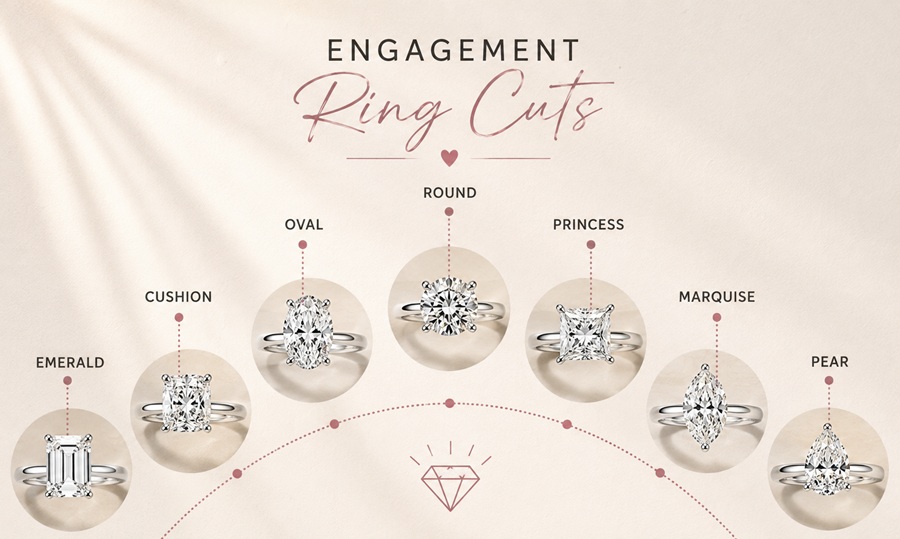
| Quick Answer
Popular engagement ring cuts include round brilliant, oval, cushion, emerald, princess, and pear. Round brilliant offers the most sparkle and is the most popular choice, while elongated cuts like oval and emerald tend to look larger per carat and suit different hand shapes and style preferences. |
Choosing a diamond cut is often the first major decision in engagement ring shopping, and it shapes nearly everything else — sparkle, perceived size, price per carat, and overall style. “Cut” refers to a diamond’s shape and faceting pattern, not to be confused with “cut grade,” which measures how well-proportioned and reflective a diamond is regardless of shape. This guide breaks down the most popular cuts so you can shop with confidence.
Comparison Table: Popular Engagement Ring Cuts
| Cut | Sparkle Level | Price (per carat) | Best For |
| Round Brilliant | Highest | Highest | Classic, maximum sparkle |
| Oval | High | Moderate-High | Elongating fingers, vintage-modern blend |
| Cushion | Moderate-High | Moderate | Romantic, soft-edged vintage look |
| Princess | High | Moderate | Modern, geometric style |
| Emerald | Lower, more clarity-forward | Moderate | Art Deco, elegant minimalism |
| Pear | High | Moderate | Unique, elongating silhouette |
| Marquise | High | Lower-Moderate | Maximizing visual size per carat |
Round Brilliant Cut
The round brilliant remains the most popular engagement ring cut by a wide margin, largely because its 58-facet structure is mathematically optimized for maximum light return. It’s the most forgiving cut when it comes to hiding minor inclusions, but it also commands the highest price per carat due to higher rough diamond wastage during cutting.
Oval Cut
Oval diamonds have surged in popularity over the past several years, largely because their elongated shape can make fingers appear longer and the diamond appear larger than a round stone of the same carat weight. One consideration: ovals can show a ‘bow-tie’ effect (a dark shadow across the center) more than other cuts, so it’s worth reviewing this closely in person or via video before purchasing.
Cushion Cut
Cushion cuts combine a square or rectangular shape with softly rounded corners, giving them a romantic, slightly vintage feel. They tend to show more fire (color flashes) than pure brilliance compared to a round cut, which some buyers prefer for a warmer, softer sparkle.
Princess Cut
Princess cuts offer a modern, geometric square silhouette with excellent brilliance, second only to round cuts in overall sparkle. They’re also more efficient to cut from rough diamond material than round stones, which often makes them slightly more affordable per carat.
Emerald Cut
Emerald cuts use a step-cut faceting pattern rather than brilliant faceting, creating a hall-of-mirrors effect rather than intense sparkle. Because this cut is more transparent, clarity imperfections are more visible, so buyers typically need to prioritize a higher clarity grade than they would with a round or cushion cut.
Pear Cut
Pear-shaped diamonds combine a rounded end with a pointed tip, creating a distinctive teardrop silhouette. Like ovals, they can show bow-tie effects and benefit from careful in-person or video inspection before purchase.
Marquise Cut
With its elongated, pointed-oval shape, the marquise cut is known for maximizing apparent size — it often appears larger than its actual carat weight compared to rounder shapes, making it a popular choice for buyers prioritizing visual impact on a moderate budget.
How to Choose the Right Cut
- Consider hand shape and finger length — elongated cuts often flatter shorter fingers
- Decide whether maximum sparkle or a softer, romantic glow matters more to you
- Factor in budget — round and oval typically command higher prices per carat
- Think about lifestyle — some cuts with pointed edges (marquise, pear) may need more protective settings for active daily wear
- View diamonds in person or via high-quality video before finalizing, since online photos can’t fully capture sparkle and color
| Tip: If budget matters and you want a larger-looking stone, oval, marquise, and pear cuts tend to offer more visual size per dollar than round brilliant diamonds of equivalent carat weight. |
Cut vs. Cut Grade: A Distinction Worth Understanding
Shoppers often conflate a diamond’s shape (round, oval, cushion, and so on) with its cut grade, which is a completely separate measurement of how well a diamond’s proportions, symmetry, and polish allow it to reflect light. Two round diamonds of identical carat weight can look dramatically different depending on their cut grade — one dazzling with brilliance, the other appearing flat and lifeless. When shopping, always ask for both the shape and the cut grade (typically rated Excellent, Very Good, Good, Fair, or Poor on major grading reports) rather than assuming shape alone determines sparkle.
Trends in Engagement Ring Cuts for 2026
Recent buying data continues to show strong, sustained demand for elongated cuts, particularly oval and, to a lesser extent, radiant, as buyers seek stones that photograph well and appear larger on the hand. At the same time, there’s been a modest resurgence in cushion and old European-inspired cuts among buyers drawn to vintage aesthetics, alongside a growing interest in unconventional shapes like hexagon and kite cuts for buyers wanting something distinctly non-traditional.
How Diamond Cut Interacts With Clarity and Color Choices
The cut you choose significantly affects how much you need to prioritize other elements of the 4Cs. Brilliant cuts like round and princess scatter light in a way that naturally masks minor inclusions and faint color tints, meaning buyers can often save money by choosing a slightly lower clarity or color grade without a noticeable visual difference. Step cuts like emerald and asscher, by contrast, act almost like a hall of mirrors — their large, flat facets make both inclusions and color far more visible, so buyers pursuing these cuts typically need to budget for higher clarity and color grades to achieve the same clean, polished look. Understanding this interaction can help you allocate your budget more strategically across the 4Cs rather than overspending uniformly.
Lab-Grown vs. Natural Diamonds Across Different Cuts
Cut selection works identically whether you choose a natural or lab-grown diamond, since lab-grown stones are chemically and optically identical to natural ones and are cut using the same techniques. The main practical difference is cost: lab-grown diamonds typically run significantly less per carat than natural stones of comparable cut, clarity, and color, which gives buyers more flexibility to choose larger carat weights or more elaborate cuts within the same budget. This has made once-premium cuts more accessible to a wider range of buyers in recent years.
Frequently Asked Questions
Which engagement ring cut has the most sparkle?
Round brilliant diamonds generally offer the most sparkle, thanks to their 58-facet design specifically optimized for light return, followed closely by princess and oval cuts.
What’s the most affordable engagement ring cut?
Princess, marquise, and emerald cuts tend to be more affordable per carat than round brilliants, since less rough diamond material is wasted during cutting.
What cut is best for a smaller budget but a bigger-looking diamond?
Oval, marquise, and pear cuts are known for appearing larger than their actual carat weight due to their elongated shapes.
Is cut the same as diamond quality?
No. ‘Cut’ refers to shape, while ‘cut grade’ is a separate measure (often on the 4Cs scale) evaluating how well a diamond is proportioned and faceted regardless of its shape.
What is the bow-tie effect in diamonds?
It’s a dark, bow-tie shaped shadow that can appear across the center of elongated cuts like oval, marquise, and pear diamonds, caused by light blockage from the wearer’s own reflection.
Conclusion
There’s no universally ‘best’ engagement ring cut — only the one that best matches your priorities, whether that’s maximum sparkle, a larger visual size, budget efficiency, or a specific aesthetic. Take time comparing cuts in person or via detailed video before committing, since photos alone rarely capture how a diamond truly performs in real light.