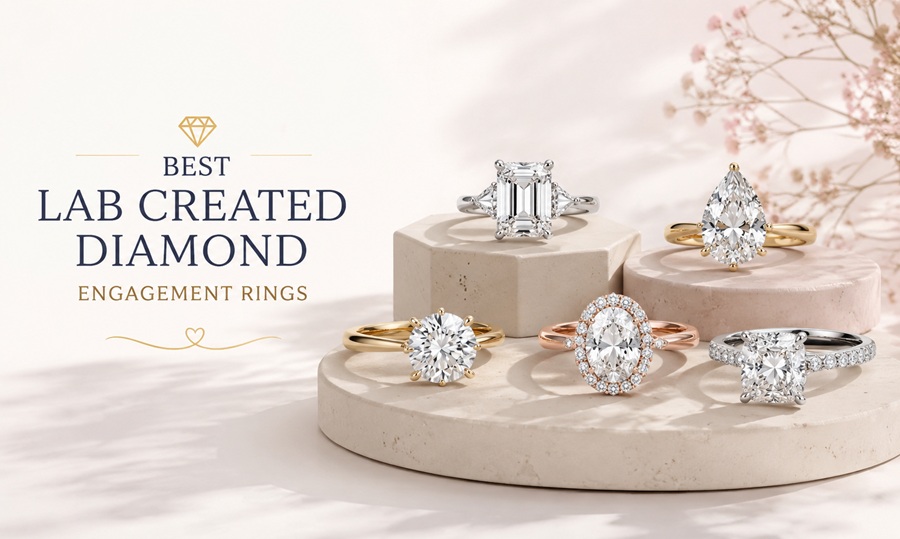
Shopping for the “best” lab created diamond engagement ring isn’t really about finding one perfect option — it’s about understanding what separates a high-quality lab diamond ring from a mediocre one, so you can evaluate any retailer’s offerings with confidence.
What Makes a Lab Created Diamond Ring “Best” for You
There’s no single universal “best” ring — the right choice depends on:
- Your budget and how much diamond size or clarity matters to you
- The ring style (solitaire, halo, vintage-inspired, three-stone) you’re drawn to
- The metal type you prefer (white gold, yellow gold, platinum)
- Whether certification and retailer reputation matter as much as design to you
The 4Cs Still Apply to Lab Created Diamonds
| C | What to Look For |
|---|---|
| Cut | The single biggest factor in visible sparkle — prioritize this over carat size |
| Color | Near-colorless grades (G–J) offer strong value without paying premium for “colorless” grades most people can’t distinguish |
| Clarity | VS1–VS2 clarity typically appears eye-clean without paying for flawless grades |
| Carat | Balance against cut and clarity rather than maximizing size alone |
Popular Ring Styles for Lab Created Diamonds
Classic Solitaire
A single diamond on a simple band — timeless, versatile, and often the most budget-efficient way to get a larger center stone since there’s no additional stone cost.
Halo Setting
A center stone surrounded by smaller diamonds, which makes the center stone appear larger and adds extra sparkle — a popular choice for maximizing visual size on a moderate budget.
Three-Stone Ring
Symbolic of past, present, and future, this style uses three diamonds of varying or matching sizes, offering more total sparkle across the ring.
Vintage-Inspired Settings
Intricate detailing, milgrain edges, and filigree work appeal to couples wanting a ring with more character than a plain modern setting.
What to Look for in a Retailer
- Certification transparency — GIA or IGI certification should be clearly provided, not vague or optional
- Return and resizing policy — a reasonable return window and free resizing within the first year is standard among reputable retailers
- Warranty coverage — lifetime warranty against manufacturing defects is common and worth confirming
- Customization options — the ability to adjust setting, metal, and stone shape independently
- Clear pricing breakdown — separate pricing for the stone and the setting, so you understand what you’re actually paying for
Budget Ranges and What to Expect
| Budget Range | What You Can Typically Get |
|---|---|
| Under $1,000 | Smaller center stone (0.5–0.75 carat), simple solitaire setting |
| $1,000–$2,500 | 1 carat+ center stone, wider style options including halo settings |
| $2,500–$5,000 | High-quality cut and clarity grades, larger or fancier settings |
| $5,000+ | Premium cut grades, larger carat weights, custom design options |
Because lab created diamonds cost significantly less per carat than mined diamonds, budgets in these ranges generally stretch noticeably further than they would for a comparable mined stone.
Questions to Ask Before Buying
- Is the diamond certified, and by which grading lab?
- What’s the return policy if the ring doesn’t fit or isn’t what was expected?
- Is resizing included, and for how long after purchase?
- Does the price include insurance appraisal documentation?
- Are the setting and stone sold separately or as a package?
Common Mistakes to Avoid
- Prioritizing carat size over cut quality, which has a bigger visual impact on sparkle
- Skipping certification to save a small amount of money
- Not asking about resizing policy before finalizing a purchase
- Choosing a setting style before confirming it works well with the stone shape you want
FAQ
Do lab created diamonds need the same certification as mined diamonds?
Yes — reputable retailers provide GIA or IGI certification for lab created diamonds the same way they would for mined stones.
Is a bigger carat size always the better choice within a budget?
Not necessarily — prioritizing cut quality often results in a more visually impressive ring than maximizing carat size alone.
Are lab created diamond rings less durable than mined diamond rings?
No — lab created diamonds share identical hardness and durability with mined diamonds, since they’re chemically the same material.
What ring setting makes a diamond look biggest for the budget?
A halo setting is commonly used to visually enlarge the center stone without the cost of a larger single diamond.
Should I buy the setting and stone from the same retailer?
It’s often simpler and can come with better warranty coverage, though some buyers choose the stone and setting separately for more customization control.
How long does a lab created diamond ring typically take to arrive after ordering?
It varies by retailer and customization level, but expect anywhere from a couple of weeks for in-stock designs to several weeks for fully custom pieces.
The “best” lab created diamond engagement ring isn’t a single product — it’s whichever ring balances cut quality, a setting you genuinely love, and a retailer with transparent certification and fair policies. Focus on those fundamentals, and you’ll end up with a ring that holds up well both visually and practically for years to come.