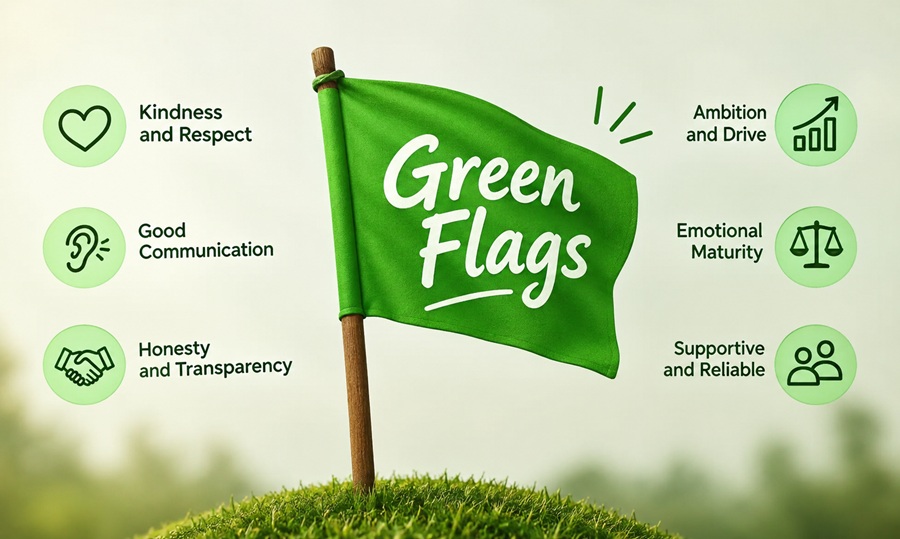
Green flags in a relationship include honest communication, mutual respect, emotional consistency, and genuine support for each other’s growth. These signs indicate a partner who’s emotionally healthy and relationship-ready, and they tend to hold up consistently over time rather than only appearing during the honeymoon phase.
Relationship advice tends to focus heavily on what to avoid — the red flags, the warning signs, the dealbreakers. Less attention goes to actively naming what a genuinely good relationship looks like day to day. Below are 20 green flags worth recognizing and appreciating if you see them in your own relationship.
1. They Communicate Instead of Assuming
They ask rather than guess, and they clarify rather than assume the worst when something is unclear. This alone prevents an enormous share of the misunderstandings that quietly erode less communicative relationships.
2. They Apologize Without Deflecting
A real apology from them sounds like ownership, not a justification wrapped in an apology-shaped sentence. They can say ‘I was wrong’ without immediately needing to explain why it wasn’t really their fault.
3. They Respect Your Boundaries
When you say no, they accept it without guilt-tripping or repeatedly testing the limit. A boundary, once stated, doesn’t need to be re-defended every time.
4. They Support Your Independent Life
Your friendships, hobbies, and personal goals aren’t treated as threats to the relationship. If anything, they actively encourage you to keep pursuing the things that make you feel like yourself.
5. They Stay Calm During Disagreement
Conflict doesn’t spiral into contempt, stonewalling, or explosive reactions. Even a heated disagreement stays focused on the actual issue rather than turning into character attacks.
6. They’re Consistent
Who they are on a good day and a hard day doesn’t swing wildly — you generally know what to expect. That predictability is a form of safety, not boredom.
7. They Follow Through
Plans and promises are generally kept, and when they can’t be, you get an honest explanation rather than silence. Their word tends to mean something.
8. They’re Curious About You
Even years in, they still ask questions and want to know how you’re changing and growing. They treat you as someone still worth discovering, not a fixed, fully-known quantity.
9. They Handle Your Vulnerability with Care
When you share something difficult, it’s met with empathy rather than judgment or dismissiveness. You never feel punished for opening up.
10. They Treat Others Well
How they treat service staff, strangers, and people who can’t benefit them says a lot about their real character. Kindness that only appears when someone’s watching isn’t really kindness.
11. They Take Accountability
Mistakes are acknowledged directly, without excessive defensiveness. They’re able to sit with having done something wrong without collapsing into shame or shifting blame elsewhere.
12. They Handle Stress Without Taking It Out on You
Bad days don’t consistently become your problem to absorb. They may need space or support during stress, but it doesn’t regularly turn into snapping at you unfairly.
13. They Celebrate Your Wins
Your success is met with genuine enthusiasm, not quiet competition or resentment. They feel like they’re on your team, not measuring themselves against you.
14. They’re Financially Transparent
Money conversations happen honestly rather than being avoided or hidden. Shared financial decisions feel collaborative rather than secretive.
15. They Speak Well of You to Others
How they talk about you when you’re not around matches how they treat you when you are. There’s no gap between your public and private experience of them.
16. They Make Room for Your Emotions
Your feelings aren’t minimized as ‘too much’ or dismissed as overreactions. Even emotions they don’t fully understand are treated as valid and worth listening to.
17. They Talk About the Future Openly
Long-term plans and goals are discussed honestly rather than avoided out of discomfort. You’re not left guessing where things are headed.
18. They Respect Your Family and Friends
Even when they don’t fully click with everyone in your life, basic respect and effort are still there. They don’t ask you to choose between them and the other important people in your life.
19. They Handle Jealousy Maturely
Insecurity, if it comes up, is communicated honestly rather than expressed through control or accusation. They’re able to say ‘that made me feel insecure’ instead of acting it out indirectly.
20. Being Around Them Feels Like Relief, Not Effort
You generally feel more like yourself, not less, in their presence — comfortable rather than constantly on guard. The relationship gives you energy more often than it drains it.
| Tip: Green flags matter most in aggregate and over time. One or two isolated positive moments don’t outweigh consistent patterns elsewhere — look at the whole picture, not a single highlight. |
Why Naming Green Flags Matters for Your Own Standards
There’s real value in consciously naming what’s working, not just watching for what’s wrong. People who can clearly articulate what healthy treatment looks like tend to have an easier time recognizing when a future relationship falls short of that standard, since they’re not relying on vague instinct alone. If you’re currently single, keeping a mental (or literal) list of the green flags that matter most to you can sharpen your radar for genuinely compatible partners going forward.
When Green Flags Coexist With Real Struggles
No relationship displays all twenty of these consistently, all the time — that’s an unrealistic standard for any two imperfect people. What matters is the overall pattern and trajectory: are these behaviors generally present and does the relationship trend toward more of them over time, or fewer? A relationship going through a genuinely hard season while still showing most of these signs is in a very different position than one where these behaviors were never present to begin with.
Frequently Asked Questions
How many green flags should a healthy relationship have?
There’s no fixed number, but the more consistently these behaviors show up across different situations and over time, the stronger an indicator they are of a genuinely healthy relationship.
Can someone show green flags early on but not really mean them?
It’s possible for someone to perform positive behaviors briefly, which is why green flags that hold up over months, especially during stress or conflict, are far more meaningful than early impressions alone.
Are green flags more important than chemistry?
They serve different purposes — chemistry fuels initial attraction, while green flags indicate long-term compatibility and emotional health, and both matter for a sustainable relationship.
What’s the most overlooked green flag?
How a partner treats people who can’t benefit them, such as service workers or strangers, is a frequently overlooked but highly reliable indicator of genuine character.
Can a relationship have green flags and still not work out?
Yes. Green flags indicate a healthy, respectful partner, but long-term compatibility also depends on shared goals, timing, and values, which can differ even between two emotionally healthy people.
Conclusion
It’s easy to get so focused on avoiding red flags that you forget to actually notice and appreciate the green ones. If several of these twenty signs consistently describe your relationship, that’s genuinely worth recognizing — not everyone gets to build something this solid, and it’s worth naming when you have.