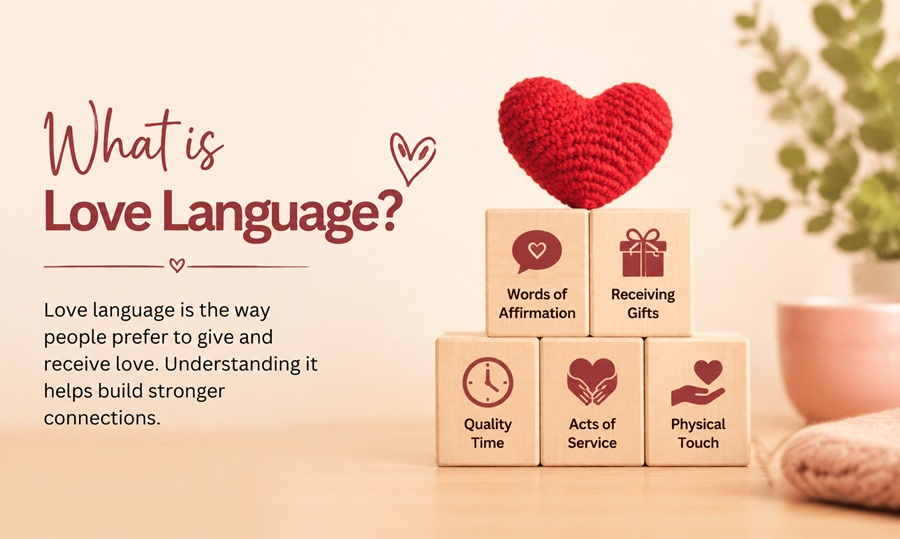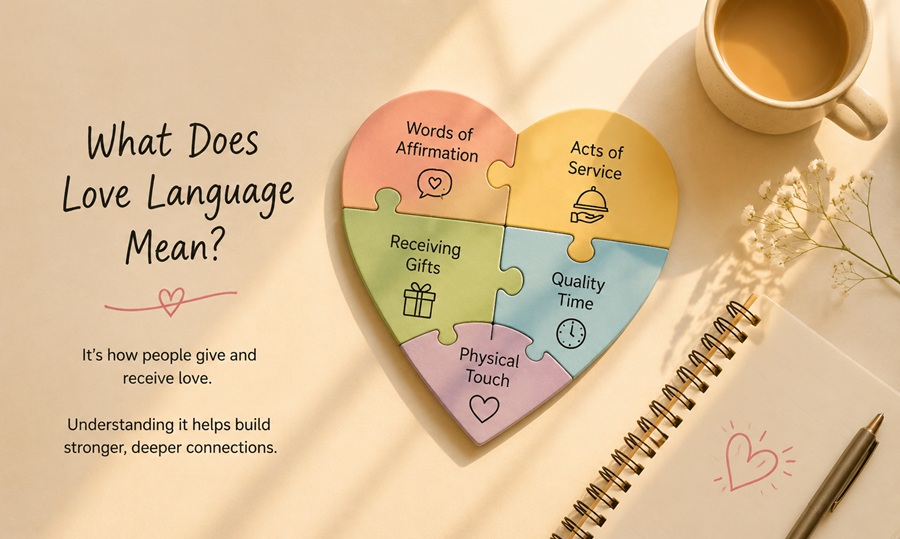
“Love language” refers to the specific way a person prefers to give and receive affection — whether that’s through words, time, actions, touch, or gifts. The term describes a communication style for love, the idea being that people don’t all experience feeling loved in the same way, even within the same relationship.
Origin of the Term
The concept was popularized by a relationship counselor and author in a widely read 1992 relationship book, which introduced five specific categories of love expression based on patterns he observed repeatedly in couples counseling over many years. The term has since become part of everyday relationship vocabulary, well beyond the book that introduced it.
The Core Idea Behind “Love Language”
The underlying premise is simple: people tend to express love the way they naturally prefer to receive it, which can create a mismatch when partners have different primary languages. A partner who shows love primarily through helpful actions might feel confused when their partner, whose language is verbal affirmation, doesn’t feel loved despite all that effort — because the effort isn’t being communicated in a way that registers for them.
The Five Recognized Love Languages
- Words of Affirmation — verbal praise, encouragement, and expressed appreciation
- Quality Time — undivided, focused attention and shared experiences
- Acts of Service — helpful actions that ease a partner’s day or burden
- Physical Touch — affectionate physical contact, from hand-holding to hugs
- Receiving Gifts — thoughtful tokens that show a partner was considered while apart
Why the Term Caught On
Part of the reason “love language” became such a widely used phrase is that it gives people simple, shared vocabulary for something previously hard to articulate — why a relationship can feel like effort is going unnoticed, even when both people genuinely care.
How the Term Is Used in Everyday Conversation
- “What’s your love language?” — a common early-dating or friend conversation to understand how someone prefers affection
- “That’s so his love language” — used to describe someone doing something characteristic of how they show love (bringing coffee, giving a compliment, etc.)
- “We have really different love languages” — often used to explain a mismatch in a relationship, without necessarily implying it’s a problem
Is “Love Language” a Scientific Term?
Not formally — it originated from relationship counseling observation rather than controlled psychological research, and some researchers have raised questions about how rigorously the five-category framework holds up empirically. That said, many therapists and relationship experts still find it a genuinely useful communication tool in practice, even if it’s not a strictly validated scientific model.
How to Use the Concept Practically
- Identify your own primary language through reflection on what makes you feel most appreciated
- Ask your partner directly about theirs rather than assuming
- Make small, occasional efforts to “speak” your partner’s language, even if it’s not naturally how you’d express affection
- Revisit the conversation periodically, since preferences can shift somewhat over time
FAQ
Who coined the term “love language”?
It comes from a marriage counselor’s 1992 book, which introduced the five-category framework based on patterns observed in couples counseling.
Is love language the same as personality type?
No — it’s specifically about how someone prefers to give and receive affection, not a broader personality framework.
Can someone’s love language change?
It can shift somewhat over time or across different relationships, though most people have a fairly consistent primary preference throughout adulthood.
Does everyone fit neatly into one love language?
Not necessarily — many people identify strongly with two, and it’s meant as a helpful framework rather than a rigid category system.
Is understanding love languages actually proven to help relationships?
It’s not backed by rigorous formal research the same way some psychological concepts are, but many couples and therapists report it as a genuinely useful communication tool in practice.
Can love language apply outside romantic relationships?
Yes — the framework is often applied to friendships, family relationships, and even parent-child dynamics.
“Love language” simply describes how a person naturally shows and wants to receive affection. Understanding the term — and identifying your own and your partner’s — gives couples a shared vocabulary for something that used to just be a source of quiet, unexplained friction.